Your Rights to Access Your Local NHS Services
 Download Poster
- A face-to-face interpreter.
- An online interpreter using Video Remote Interpreting (VRI), if appropriate.
- Deaf.
- A British Sign Language (BSL) user.
- Require a BSL/English interpreter for appointments.
- Your medical condition.
- The proposed treatment.
- The benefits and risks.
- Any alternative options.
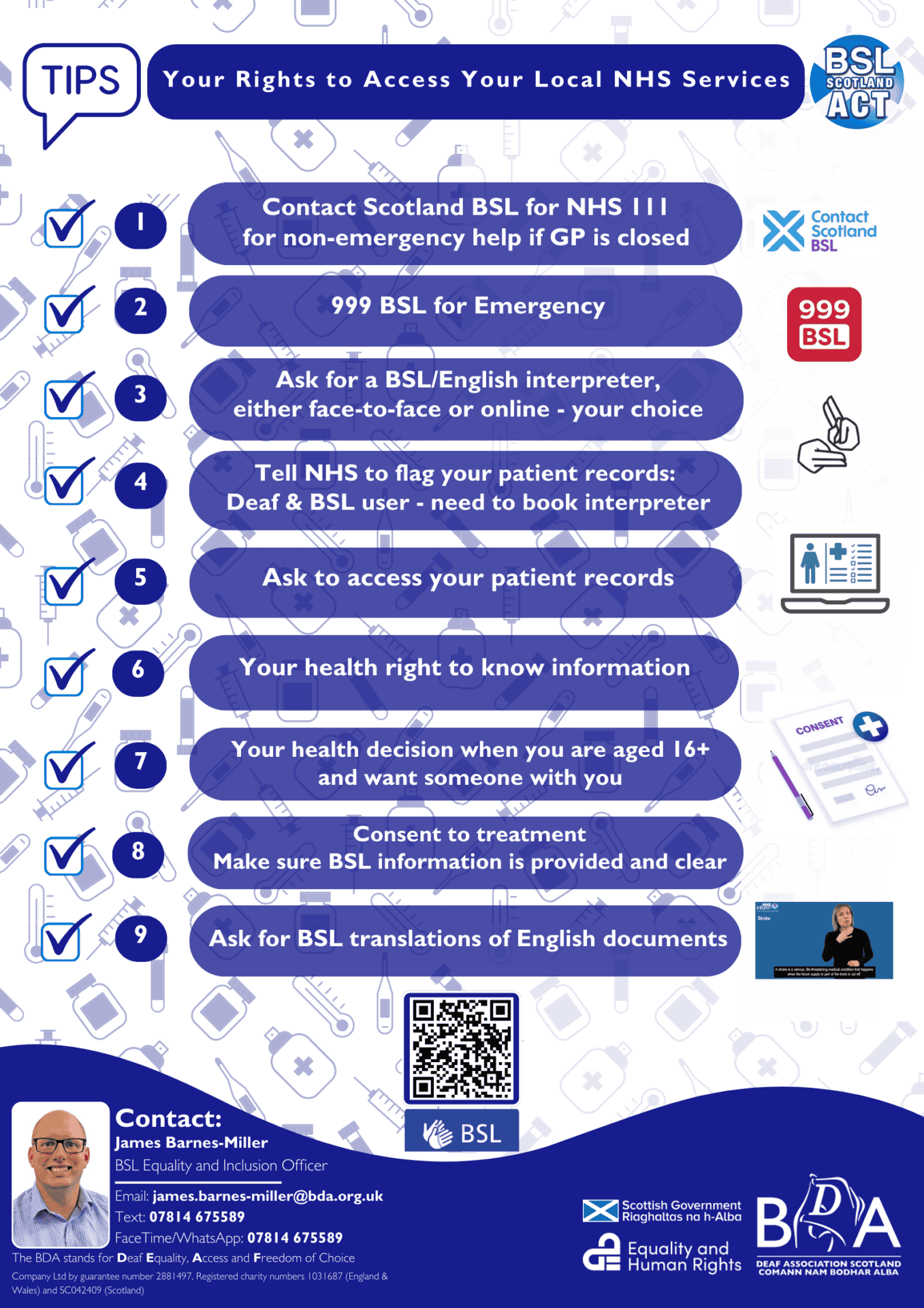
1. Contact Scotland BSL for NHS 111 for non-emergency help if GP is closed
If your GP surgery is closed and you need non-emergency medical advice, you can use Contact Scotland BSL to contact NHS 111.
This service allows Deaf BSL users to communicate with NHS staff through a qualified BSL/English interpreter.
2. 999 BSL for Emergency
If you need urgent emergency assistance, use the 999 BSL service to contact the emergency services in British Sign Language.
Only use this service in a genuine emergency.
3. Ask for a BSL/English interpreter, either face-to-face or online – your choice
You have the right to request a qualified BSL/English interpreter for NHS appointments.
You can choose:
Your communication preferences should be respected whenever possible.
4. Tell NHS to flag your patient records: Deaf & BSL user – need to book interpreter
Ask your GP surgery or NHS service to add a communication note to your patient record stating that you are:
This helps ensure appropriate communication support is arranged in advance.
5. Ask to access your patient records
You have the right to request access to your personal health records.
If you need support to understand the information, ask the NHS to provide it in an accessible format.
6. Your health right to know information
You have the right to receive health information in a way that is accessible and easy to understand.
If written English is not your preferred language, ask whether information is available in BSL or another accessible format.
7. Your health decision when you are aged 16+ and want someone with you
If you are aged 16 or over, you have the right to make decisions about your healthcare.
If you would like someone to support you during an appointment, discuss this with your healthcare provider.
8. Consent to treatment Make sure BSL information is provided and clear
Before giving consent, healthcare professionals should make sure you understand:
Ask for information to be provided in BSL if this helps you make an informed decision.
9. Ask for BSL translations of English documents
You can ask for important NHS information or documents to be explained or translated into British Sign Language where appropriate.
This can help ensure you fully understand information about your healthcare.
Contact
James Barnes-Miller
BSL Equality and Inclusion Officer
Email: james.barnes-miller@bda.org.uk
Text: 07814 675589
FaceTime / WhatsApp: 07814 675589