7 Tips for Better BSL Access in Scottish Public Services
 Download Poster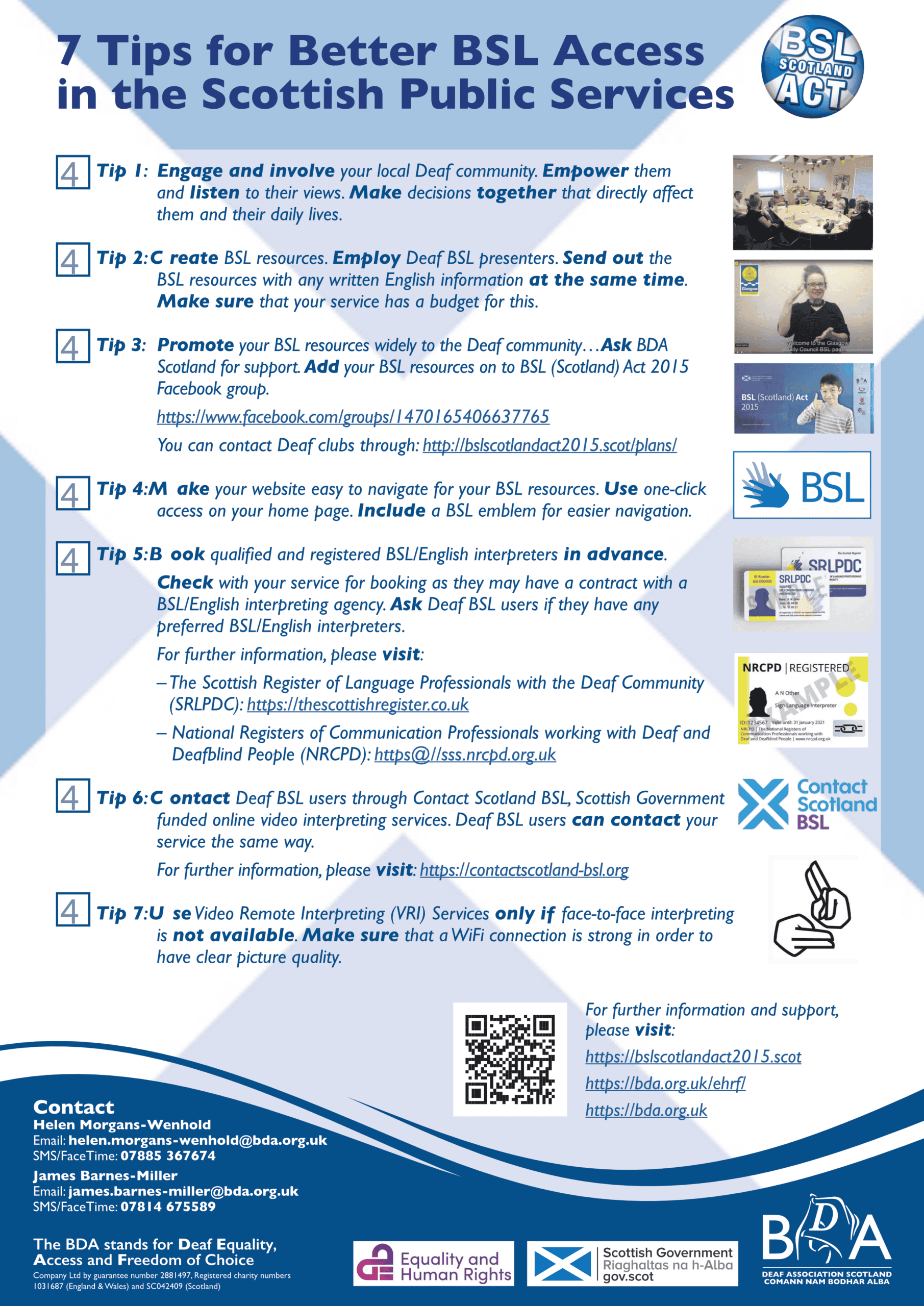
- The Scottish Register of Language Professionals with the Deaf Community (SRLPDC):
https://thescottishregister.co.uk - National Registers of Communication Professionals working with Deaf and Deafblind People (NRCPD):
https://sss.nrcpd.org.uk
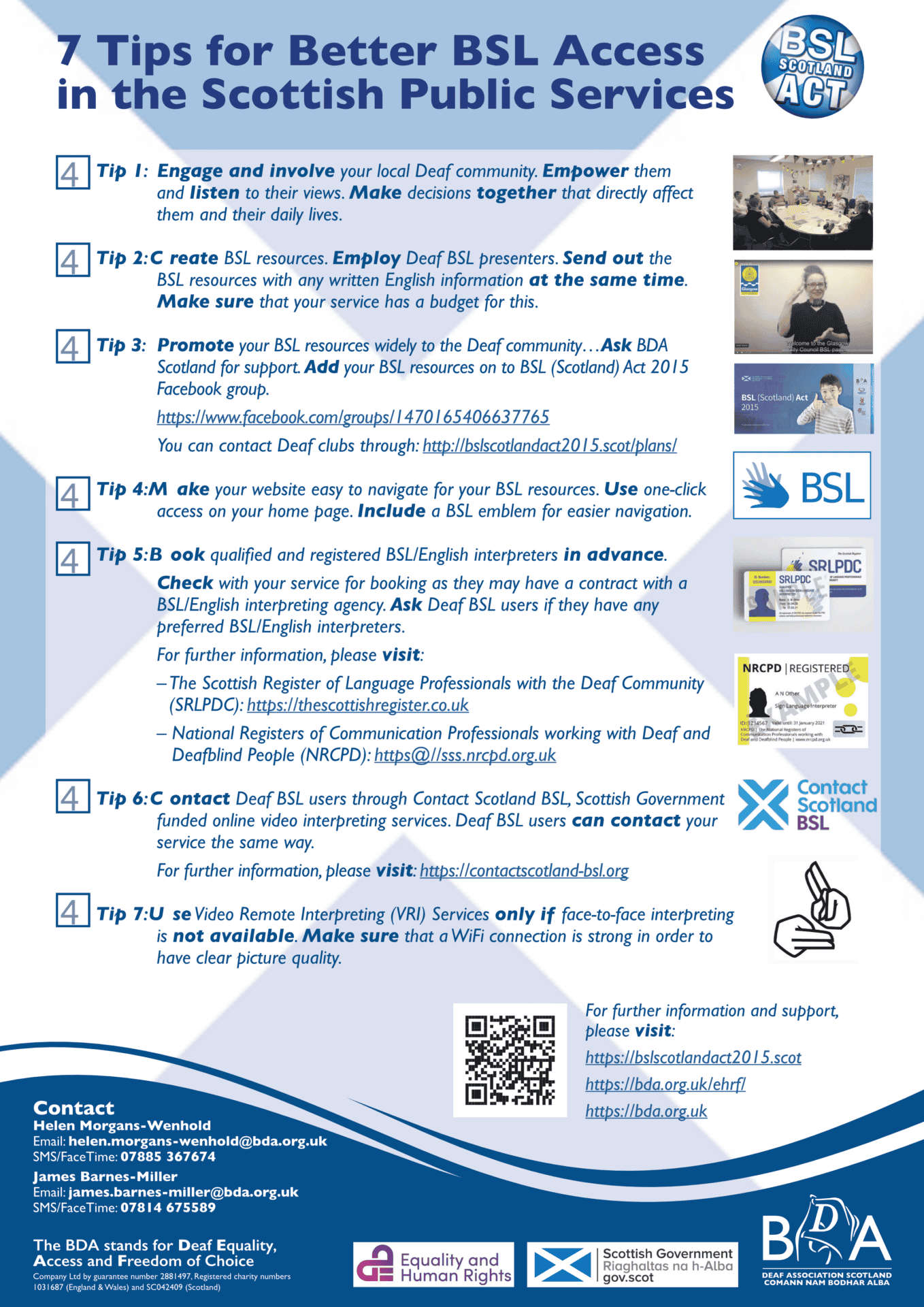
Tip 1 – Engage and involve your local Deaf community. Empower them and listen to their views. Make decisions together that directly affect them and their daily lives.
Tip 2 – Create BSL resources. Employ Deaf BSL presenters. Send out the BSL resources with any written English information at the same time. Make sure that your service has a budget for this.
Tip 3 – Promote your BSL resources widely to the Deaf community…Ask BDA Scotland for support. Add your BSL resources on to BSL (Scotland) Act 2015 Facebook group.
https://www.facebook.com/groups/1470165406637765
You can contact Deaf clubs through:
http://bslscotlandact2015.scot/plans/
Tip 4 – Make your website easy to navigate for your BSL resources. Use one-click access on your home page. Include a BSL emblem for easier navigation.
Tip 5 – Book qualified and registered BSL/English interpreters in advance.
Check with your service for booking as they may have a contract with a BSL/English interpreting agency. Ask Deaf BSL users if they have any preferred BSL/English interpreters.
For further information, please visit:
Tip 6 – Contact Deaf BSL users through Contact Scotland BSL, Scottish Government funded online video interpreting services. Deaf BSL users can contact your service the same way.
For further information, please visit:
https://contactscotland-bsl.org
Tip 7 – Use Video Remote Interpreting (VRI) Services only if face-to-face interpreting is not available. Make sure that a WiFi connection is strong in order to have clear picture quality.
For further information and support, please visit:
https://bslscotlandact2015.scot
Contact
Helen Morgans-Wenhold
Email: helen.morgans-wenhold@bda.org.uk
SMS / FaceTime: 07885 367674
James Barnes-Miller
Email: james.barnes-miller@bda.org.uk
SMS / FaceTime: 07814 675589